


By Howard W. Penrose, Ph.D., CMRP
Motor Diagnostics and Motor Health Newsletter
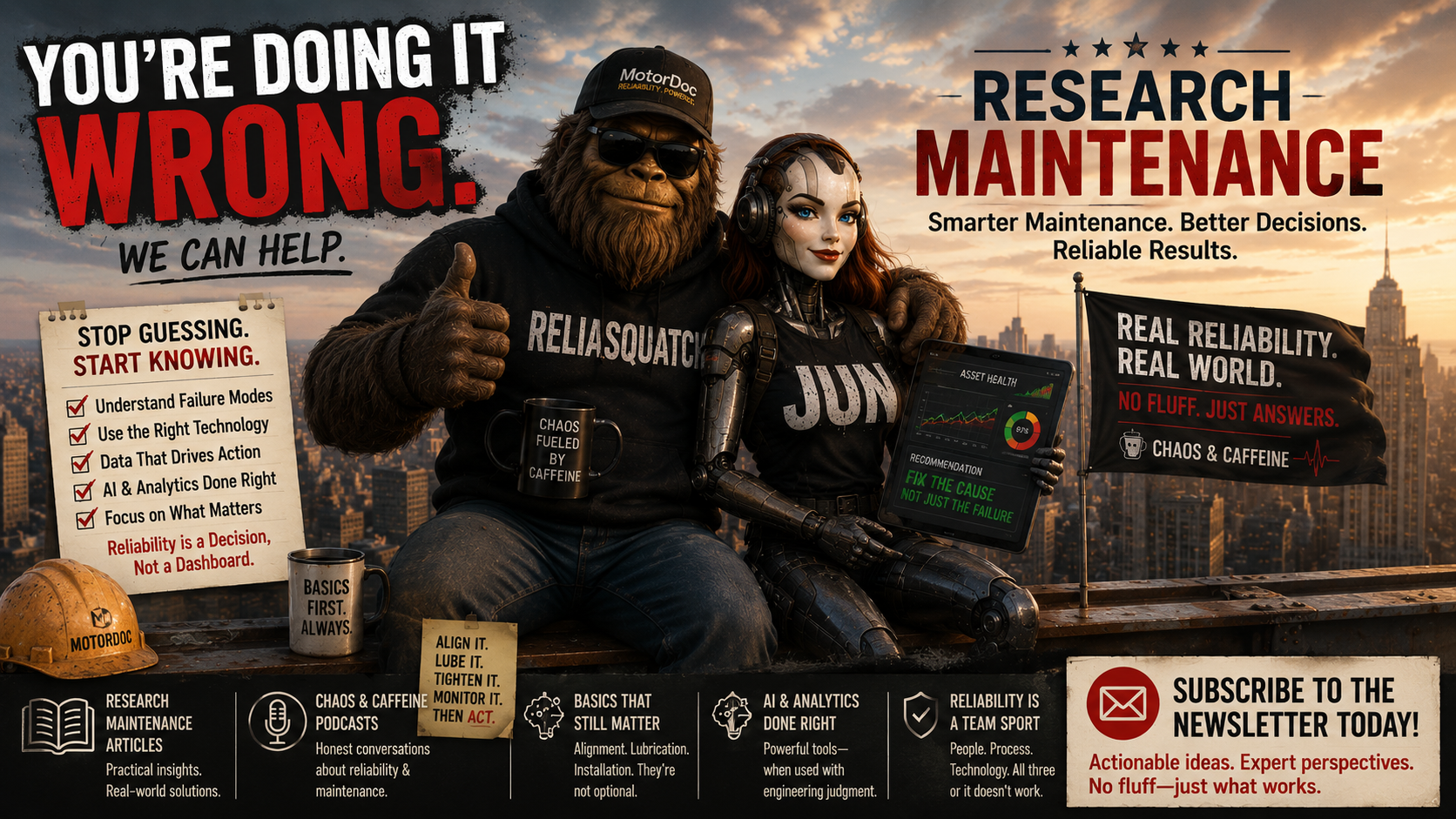
Apparently, I have spent a good portion of the past several months telling people, “You’re doing it wrong.” Between the recent LinkedIn articles, reliability discussions, and Chaos and Caffeine podcasts, a pattern has emerged. We have more sensors, software, dashboards, artificial intelligence, machine learning, wireless systems, and acronyms than at any point in maintenance history. Naturally, equipment still fails because someone forgot to lubricate it.
One of the recurring points in our recent articles has been that maintenance is not reliability, and reliability is not corporate strategy. Reliability is what allows the corporate strategy to survive contact with actual machinery. Management may have a magnificent five-year plan, complete with attractive graphics and arrows pointing upward. Unfortunately, the gearbox has not read the plan. It only knows that it is misaligned, running hot, and has been making that noise for six months.
We see the same problem with condition monitoring. Installing sensors does not automatically create a condition-based maintenance program. Sometimes it creates a very expensive system for watching a machine fail in high definition. If the vibration increases, the current signature changes, the temperature rises, and everyone responds by saying, “Let’s continue trending it,” congratulations. You are no longer performing predictive maintenance. You are producing a documentary.
This came up repeatedly in the podcasts as well. We have discussed getting back to maintenance basics before piling advanced technology on top of bad practices. There is something wonderfully human about installing artificial intelligence on a machine that was never properly aligned. The AI may eventually determine, with extraordinary computational sophistication, that the machine is unhappy. The mechanic standing beside it may have reached the same conclusion because the coupling is smoking.
That does not mean advanced diagnostics are unnecessary. Quite the opposite. Electrical Signature Analysis, vibration, ultrasound, thermography, machine learning, and continuous monitoring can provide extraordinary insight into machine condition. But the objective is not to collect impressive data. The objective is to answer a rather less glamorous question: What are we going to do about it?
We have also been discussing the growing role of AI. AI has enormous potential in reliability, diagnostics, and condition monitoring. It can identify patterns humans miss, process enormous quantities of information, and improve consistency. It also possesses one capability that deserves considerably more attention: it can be wrong at breathtaking speed while presenting the answer in a beautifully formatted paragraph. This is why subject-matter expertise remains important. A computer confidently identifying a nonexistent defect is not advanced reliability. It is automation with self-esteem.
Silus Barnaby joined one of the recent Chaos and Caffeine discussions to look at another entertaining consequence of our fascination with “smart” systems: cybersecurity. We can now install wireless monitoring systems capable of missing the developing machine fault while simultaneously broadcasting operating information to people who were never supposed to see it. Progress is a remarkable thing. The basic lesson was less glamorous: install the system correctly, secure the network, understand where the data goes, keep humans involved, and make sure you actually own your information.
Perhaps that is the common theme running through all of these discussions. Reliability does not come from buying something. It comes from understanding something. Why is the bearing failing? Why is the motor running hot? Why is the current signature changing? Why are we performing this maintenance task? Why did we install this sensor? What decision will the information change?
If the same bearing fails every six months and your maintenance crew has become so good at replacing it that they can do the job before lunch, you have not achieved reliability. You have developed a motorsports team. Reliability begins when somebody becomes annoying enough to ask why the bearing keeps failing.
The same applies to technology. There is nothing wrong with AI, continuous monitoring, predictive analytics, digital twins, or advanced diagnostics. We work with many of these technologies ourselves. The problem starts when technology becomes a substitute for engineering judgment. A dashboard cannot align a machine. Machine learning cannot compensate for poor installation. A wireless sensor cannot lubricate a bearing. At some point, someone still has to walk over to the equipment and fix something.
So, are you doing it wrong?
Probably.
So are the rest of us.
That is actually the useful part. Reliability improves when we are willing to discover that an assumption was wrong, a maintenance interval was wrong, a diagnosis was wrong, or the shiny new technology did not solve the problem we thought it would.
Keep the technology. Keep the diagnostics. Keep experimenting with AI. Keep collecting useful information.
But every once in a while, close the dashboard and look at the machine.
It has probably been trying to tell you something for months.
About The Author